Squad Tactics: Commanding Your Army
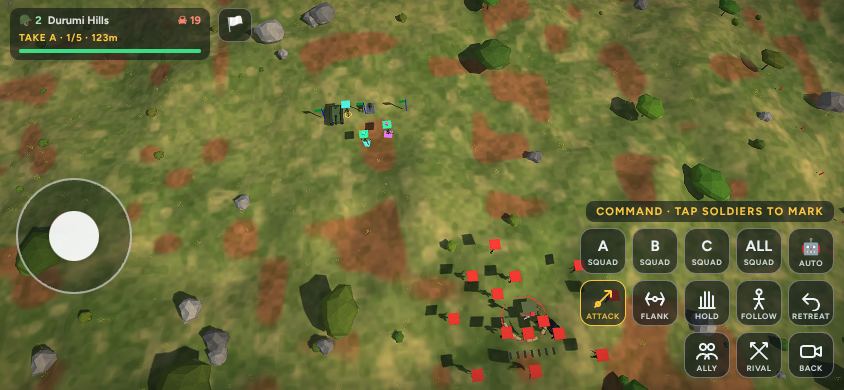
In Abuja World: Frontline you are both a soldier and a commander. Your army of up to 30 soldiers fights on its own, but the orders you give decide where the battle is won. This guide explains how your troops think and how to direct them.
How your soldiers fight
Every soldier on the field, on both sides, follows the same training:
- Cover to cover. In contact with the enemy, soldiers move in short dashes of about 25 metres from one rock, wall or sandbag to the next, then crouch.
- Lean and shoot. Behind cover they crouch, lean out to fire and duck back. A soldier in cover takes far less damage.
- Cover each other. Soldiers pair up in buddy teams: one waits and covers while the other moves.
- Fire discipline. Soldiers on the move only shoot at close threats. Defenders in their positions hold their fire until attackers come within about 60 metres.
- Suppression. Under heavy fire soldiers stay down and shoot less accurately.
- Wounded fall back. A badly hurt soldier pulls back out of the line of fire, then returns.
The front line
The two armies do not mix into one crowd. They hold a front line, and its distance depends on who is winning. When the sides are even, your squads hold about 40 metres from the enemy positions and trade fire. When you are clearly stronger, they close in to take the position. When you are losing, they give ground. Defenders dug in at their positions count as twice as strong, so you usually need to wear them down before your soldiers will push in.
Each battle opens with your army advancing in silence. Nobody fires until the lines come into range, so use those first seconds to pick your path.
The five orders
| Order | What happens | When to use it |
|---|---|---|
| Attack | Squads advance on the current objective from cover to cover and work round the enemy's sides. | The default. Most of the time. |
| Flank | A pincer: squad A swings wide left, squad C wide right, squad B pins the enemy from the front. | Against a strong, dug-in line that a frontal attack can't break. |
| Hold | Squads stay where they are and defend. | When the enemy counterattacks, or while you rescue hostages. |
| Follow | Squads stay close to you and fight around you. | When you want to lead from the front, or move the whole army somewhere specific. |
| Retreat | Everyone falls back to the safe zone and heals. | When most of your soldiers are wounded. Nobody retreats until you say so. |
The Command View
Tap COMMAND to rise above the battlefield. From here you can:
- Tap A, B, C or ALL to select a squad.
- Tap individual soldiers to mark them; tap more to add them.
- Tap the ground to send everyone marked to that spot. They spread out and take cover there.
- Tap AUTO to let them choose their own fights again.
Use it to put a squad on a hill that overlooks the enemy line, to protect your flank against a counterattack, or to send soldiers to guard a rescued prisoner.
Reinforcements and the enemy's reserves
When your soldiers fall, reserves arrive automatically if you have them, or you can buy replacements in the battlefield shop. The enemy also has reserves: when you are winning at a position, it rushes men up from the next sector, and from time to time it launches a counterattack round one of your flanks. Watch the messages at the top of the screen; they tell you where the attack is coming from.
Tanks and armoured trucks
You start every battle with two tanks crewed by your soldiers, and you can field two at a time. Tanks advance behind your infantry and fire their 120mm gun at enemies within about 75 metres. You can also climb into a tank yourself with the TANK button. Enemy armour appears in the later sectors, so keep a grenadier or your own tank ready for it.
Five tactical tips
- Clear the closest defenders before the far ones; your soldiers will push in sooner.
- Use Flank on the last two sectors, where the enemy line is longest.
- Switch to Hold the moment you see the counterattack warning.
- Bring a medic squad: they heal everyone near them.
- Don't leave your army behind. A lone commander is the enemy's favourite target.